
How Purpose Evolves from something you Seek to something You Are
A Deep Dive on Finding your Calling —and Transcending It


“Don’t ask what the world needs. Ask what makes you come alive, and go do it. Because what the world needs is people who have come alive.”
Howard Thurman
Part I: The Crisis You Didn’t Know You Were In
Have you noticed how your life becomes fixated on what you believe will give it meaning?
It might be the right career. A relationship. Success, achievement, recognition. Finally discovering your “calling”—the thing that will make everything click into place.
We’ve been taught that purpose is “out there”, something to be found, discovered, or achieved in the external world. So we dedicate our lives to searching, striving, achieving, and becoming.
And then something strange happens.
We finally attain our dreams.
We reach the summit we spent years climbing. And after the initial euphoria dissipates... we’re empty again. We want again. And like a madman, we try to fill the void with the next thing, the next achievement, the next becoming.
Mid-life crisis. Post-success emptiness. Existential drift.
These aren’t aberrations.
They’re the inevitable result of a fundamental misunderstanding about what purpose actually is and where it can be found.
The emptiness is still there, louder than ever.
The Invisible Engine
Why does this happen?
Have you ever thought something like this:
“When I get the job, I’ll be happy.”
“When I get the partner, I’ll be whole.”
These thoughts come from a set of beliefs so invisible, so woven into the fabric of our existence, that they run our lives.
The invisible equation that runs your life:
Me + Object / Person / Experience = Wholeness
This belief drives everything. It’s the invisible engine beneath every striving, every achievement, every desperate reach toward the next thing that will finally complete us.
It operates from a worldview of lack.
It confirms the hidden belief that you alone, as you are, are not enough and need something external to complete you.
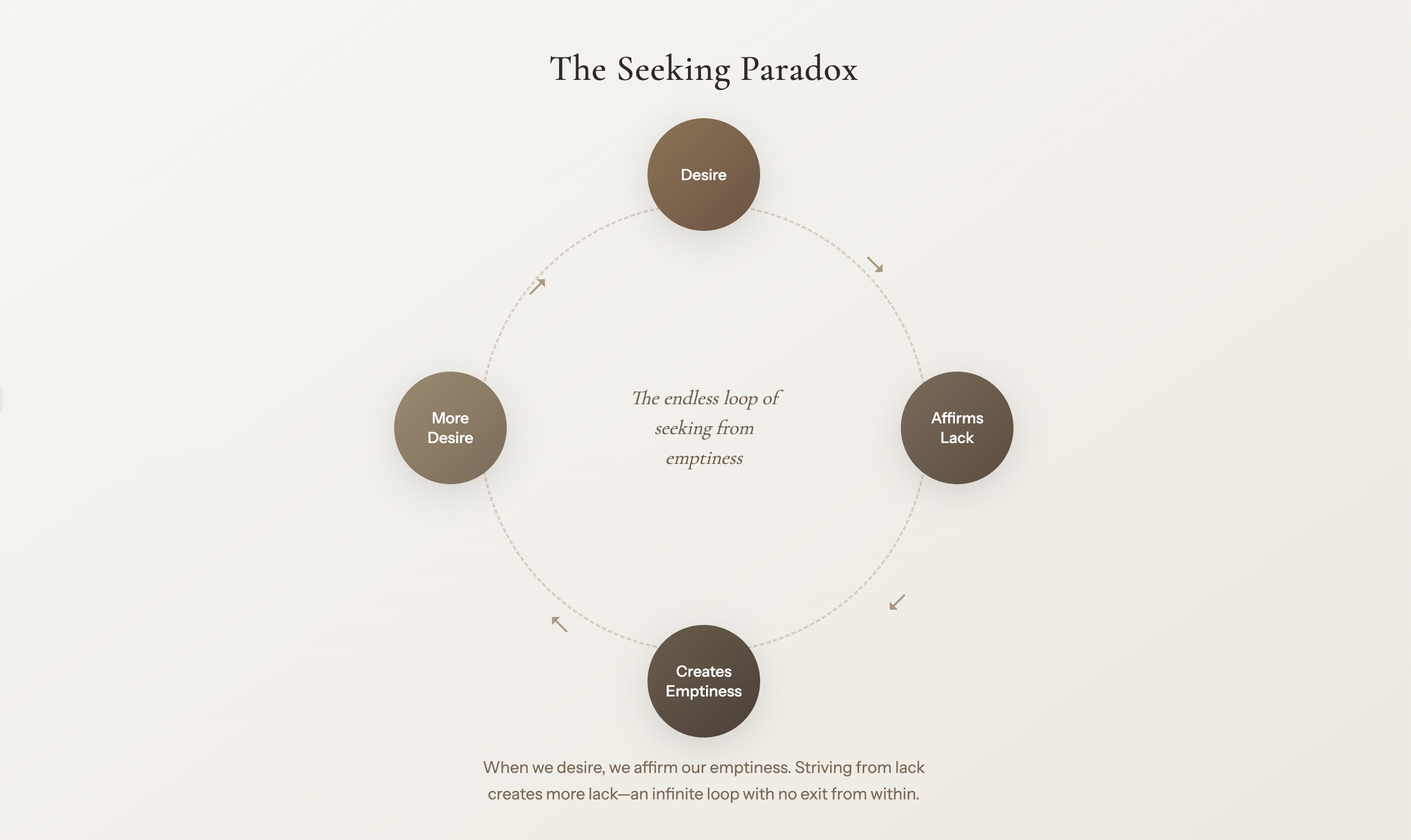
Then each desire is an affirmation of your emptiness and lack.
Read that again.
When we desire, we are actually affirming our state of lack, our emptiness.
Desire is the sensation of lack.
When we obtain what we want, we have a temporary moment of freedom from desire. We get that shiny toy and we are happy for a moment or two, which confirms our belief and ensures more desires emerge.
We then enter a cycle where we start to envision another object, person, or experience, and our desire intensifies.
We have more and more desires, failing to see how our equation has totally failed.
Desire and attainment didn’t make us whole; instead, they made us want more.
With each new desire, we experience more and more lack, more emptiness.
Even when we achieve everything we dreamed of, eventually we ask, “Is this it? ”.
And a midlife crisis ensues.
It isn’t a crisis of failure; it is a crisis of success.
You played the game, you won the prize, and you found the box was empty.
More, better, different—none of it will solve this problem. It only feeds the fire.
In this way, striving from emptiness can only ever create more emptiness.
Desire itself is emptiness.
What You’re Actually Seeking
Notice something about everything you desire — career, relationship, wealth, success, purpose itself.
What ultimately motivates the desire?
One belief: that having it will bring you happiness.
Would you want any of these things if they made you miserable? Of course not. You don’t actually want the thing. You want the state of joy, peace, and fulfillment you believe the thing will give you.
This is the first crack in the illusion.
What appears as a “purpose crisis” is actually a meaning-making crisis rooted in false beliefs about what will fulfill you. We’re not lacking purpose. We’re operating from beliefs that make purpose impossible to recognize.
Most people think they need to find new purpose “out there.”
What they actually need is to question the beliefs that created the false sense of lack “in here.”
Part II: The Search in All the Wrong Places
There’s a Sufi story about Nasrudin searching for his keys under a streetlight.
A friend asks, “Is this where you lost them?”
Nasrudin replies, “No, I lost them in my house.”
“Then why are you looking here?”
“Because the light is better here.”
We search for purpose where it’s easiest to look — in careers, achievements, roles, relationships. Not because that’s where purpose lives, but because everyone else is looking there too. The light is better there. The path is well-worn. The metrics are clear.
But the keys were never under the streetlight.
The Cultural Programming
From the moment we’re born, we’re taught what success looks like.
Graduate. Get a good job. Climb the ladder. Buy a house. Start a family. Follow the script and you’ll be happy.
So we adopt society’s definition of purpose: career becomes identity, achievement becomes validation, and success becomes the measure of a life well-lived.
We’re told to “find our passion” as if purpose is hiding somewhere out there, waiting to be discovered like buried treasure.
So we search desperately — career tests, personality assessments, endless exploration — always looking externally for something that was never external to begin with.
And because our purpose is externalized, we measure it relative to others.
We compare.
Their success, their clarity, their apparent fulfillment.
We measure our life against the highlight reels of theirs, feeling inadequate by comparison.
We don’t realize we’re comparing our insides to their outsides, our reality to their performance.
The Anxiety Machine
When purpose is externalized, life becomes anxiety.
Every moment becomes a means to an end.
Work becomes a means to success.
Success becomes a means to recognition.
Recognition becomes a means to feeling worthy.
Even you become a means to your own ends, a tool for producing the success that will finally make you whole.
This creates a trap: we become dependent on external conditions that inevitably change.
The job ends. The relationship shifts. The achievement fades. The recognition dries up. And suddenly we’re lost again, scrambling for the next external anchor.
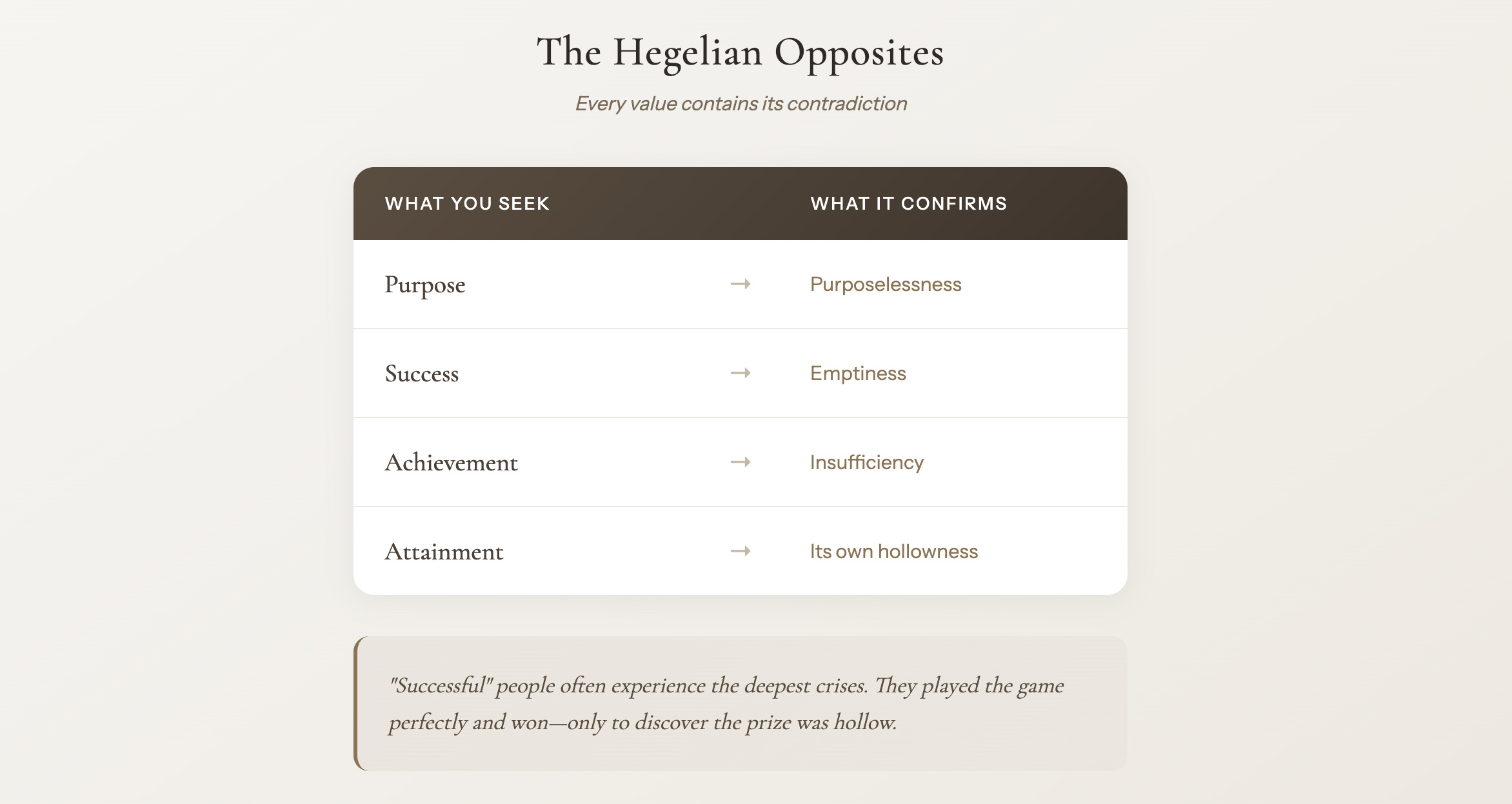
In very Hegelian terms, every value, every purpose, every desire contains its opposite:
Seeking Purpose confirms you feel purposeless.
Chasing Success reveals your emptiness.
Needing Achievement confirms your insufficiency.
Attaining your desire affirms emptiness.
This is why “successful” people often experience the deepest crises.
They played the game perfectly and won, only to discover the prize was hollow. The external path worked exactly as promised, which revealed that it doesn’t work at all.
The Grace of Failure
But here’s what we miss in our despair:
When external purposes collapse, the real search finally begins.
The breakdown isn’t the end. It’s the breakthrough that makes authentic purpose possible.
Every spiritual tradition points to this moment.
The dark night of the soul.
The hero’s descent into the underworld.
The death that precedes resurrection.
External purpose had to fail.
Not because you chose wrong, but because external purpose always fails. It was never yours to begin with.
And that failure, that disillusionment, that shattering IS Grace. It’s the opening through which something real can finally emerge.
This is captured quite well in the scene from Soul (2020). Here Joe Gardner finally achieves his dream of playing with Dorothea Williams, it was grand and afterward life goes on.
Part III: The Turn Inward
Your purpose is your purpose.
So it can never be found “out there.”
It can only be found “in here.”
But how do you gain clarity about what that purpose actually is?
The Recognition
First, recognize what you’re truly seeking.
Everything you desire — career, relationship, wealth, success — is ultimately motivated by one belief: that having it will bring you happiness.
So it’s happiness itself that you seek, not the object in itself.
But happiness or joy or peace does not require having any objects, success, or status.
These are not states of HAVING but states of BEING.
For example, right now, there is tremendous peace all around you.
Look around.
Is there any real conflict here in this moment, not in your thoughts about the past or future or some far-off place, but here and now in this very moment?
The vast majority of the turmoil you experience lives only in your thoughts about imagined situations.
The present moment, stripped of mental commentary, is almost always okay.
Often, it’s more than okay.
It’s alive, spacious, and peaceful.
From this place of recognition, peace is already here and available to you.
In fact, every state of being —such as joy, happiness, peace — is already here and fully available to you right now.
Realizing this will transform your relationship with the world, allowing you to stop grasping from a place of lack and seeking to fulfill yourself.
Instead, you’ll be able to come from a place of natural abundance, explore with curiosity; and align with a purpose that extends beyond yourself.
Finding Your Reason for Being
What is your reason for being?
Below is one of the best frameworks for discovering a higher purpose that extends beyond yourself.
The Japanese call this “ikigai”—your reason for being.
Ikigai is the intersection of what you love doing, what you’re good at, what the world needs, and what you can be paid for.
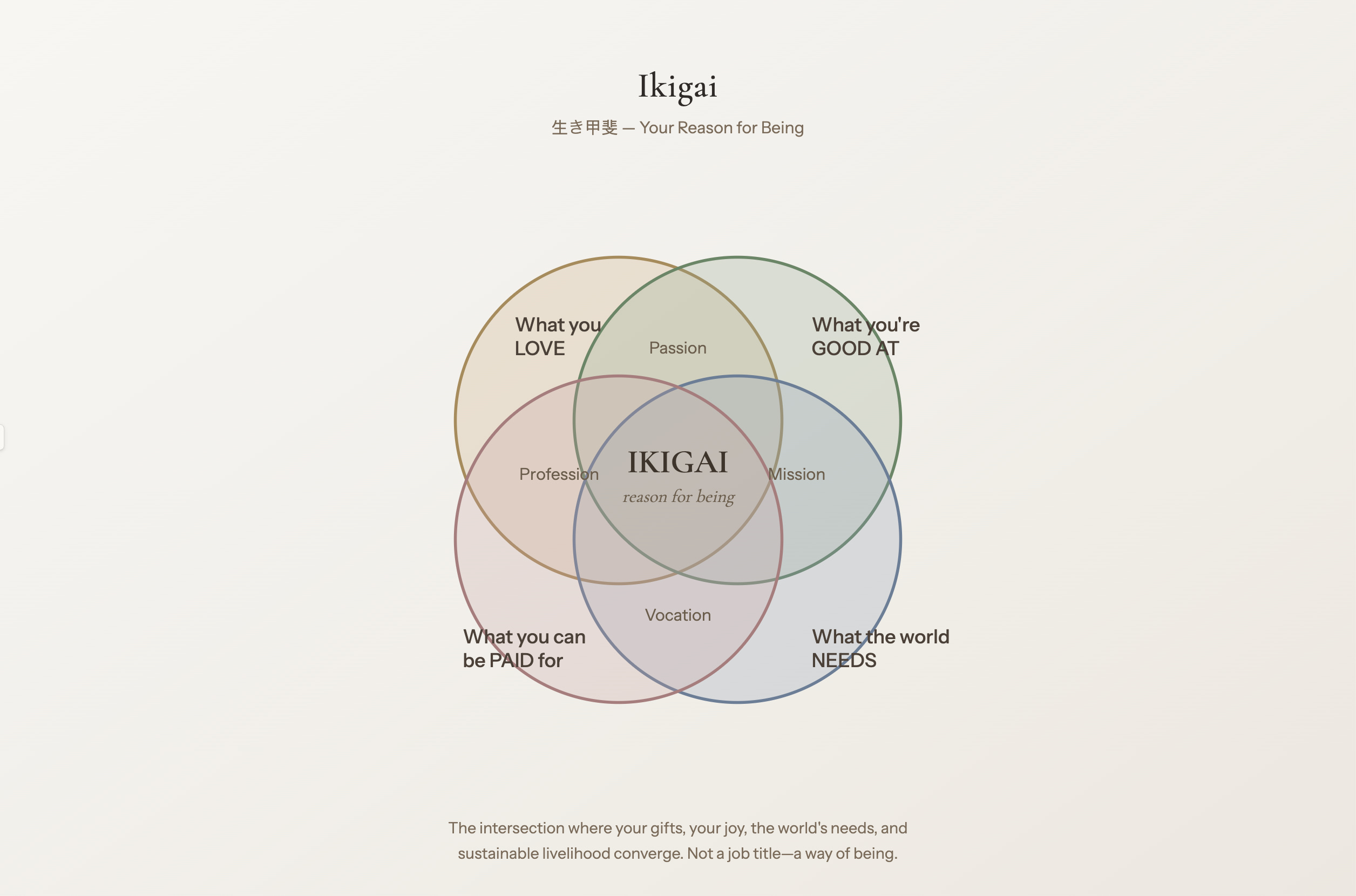
This isn’t about finding a job title. It’s about finding the overlap where your gifts, your joy, the world’s needs, and sustainable livelihood converge.
Once you identify this intersection, ask deeper questions:
What would life be like if I lived this way?
Who would I become?
Consider who you will become. Is this the best version of yourself?
Refine the vision. Play with it in your imagination—who you want to become, what you want to contribute, and what the world needs.
When you hit it, you’ll feel it click.
A spark. An “aha.” A resonance in your body that says yes.
Your purpose is that which makes you come alive.
The Alignment
Now consider: Who do you need to become to bring this vision forth?
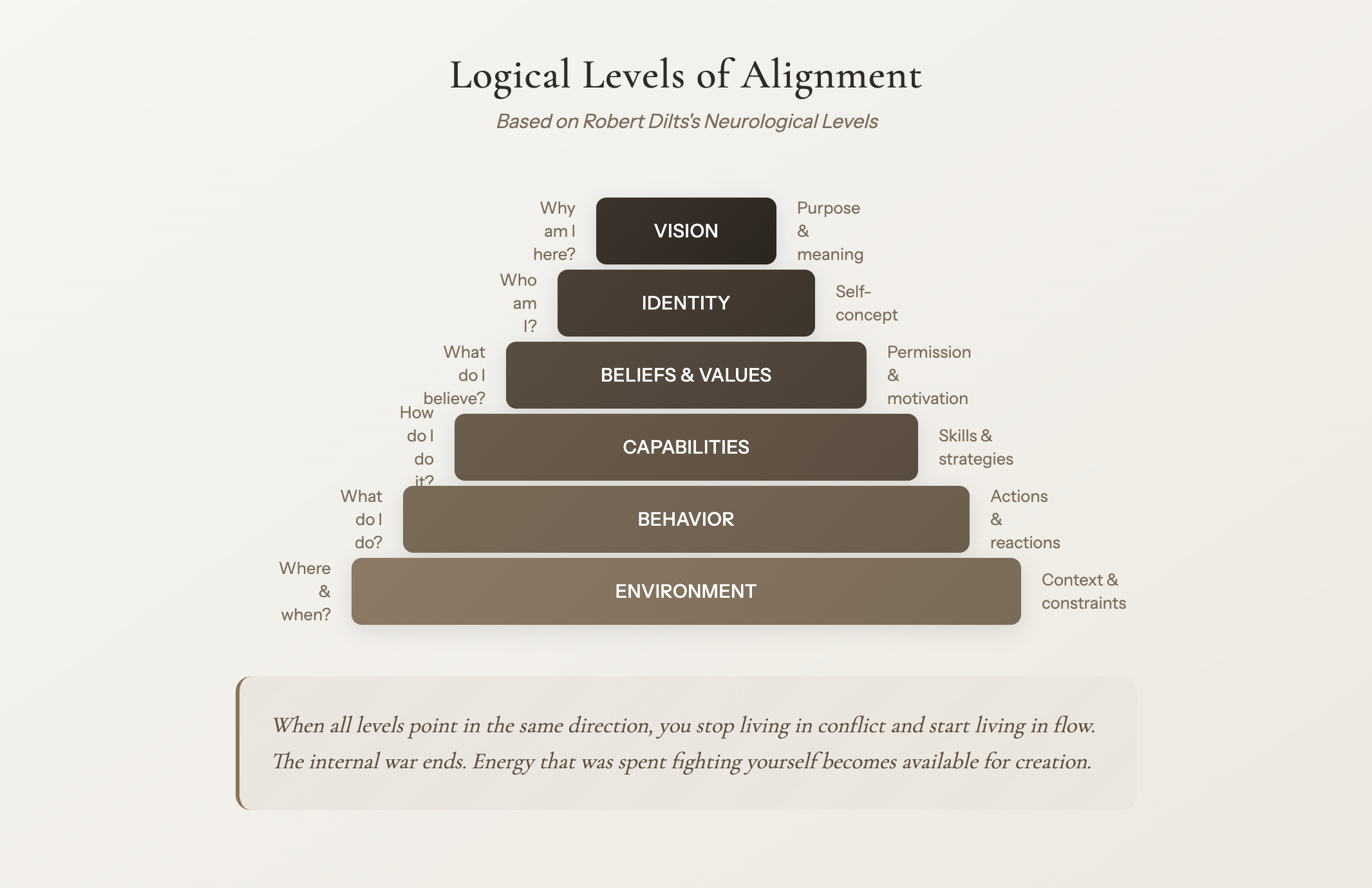
What must shift in your identity, beliefs, capabilities, behaviors, and environment to align with this purpose?
There are maps for this internal alignment—frameworks like Dilts’s Logical Levels that show how vision shapes identity, identity shapes beliefs, beliefs shape capability, and capability shapes behavior.
What matters is this: When all levels point in the same direction, you stop living in conflict and start living in flow. The internal war ends. Energy that was spent fighting yourself becomes available for creation.
Vision → Identity → Beliefs → Capabilities → Behavior → Environment.
This alignment is the beginning of your journey. Not the end. The beginning
These maps have their place. They can show you where the misalignment lives, where the resistance hides, and what level needs attention.
But a map of the ocean is not the ocean.
And eventually, even the most elegant map must be set aside when you realize you were never separate from the territory.
Part IV: The Stages of Becoming
A caterpillar’s purpose is to eat and grow.
This works perfectly, until it doesn’t.
The caterpillar can’t become a butterfly by eating more leaves.
It must undergo a complete transformation, dissolving everything it was to become something entirely different.
Your purpose works the same way.
What serves you at one stage becomes a prison at the next.
The journey isn’t finding one purpose; it’s evolving through stages of purpose.
How Purpose Evolves
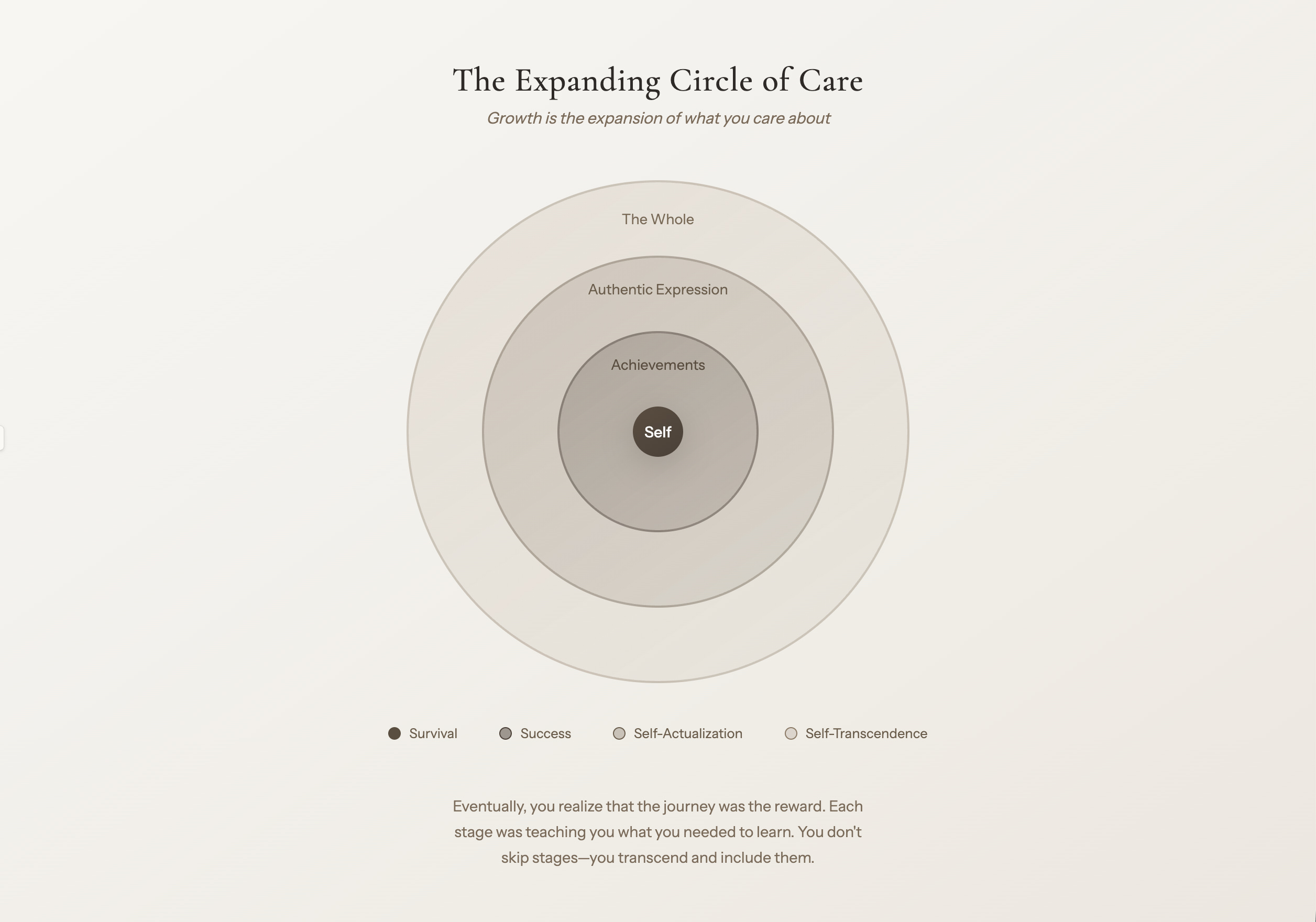
Stage 1: Survival
Early in life, purpose is about survival: getting your basic needs met, building safety, establishing belonging.
This is deficiency-driven purpose—fixing what’s missing. And it’s completely valid. You can’t skip this stage. The foundation must be built.
Core question: “Am I safe?”
Stage 2: Achievement
Once survival is handled, purpose shifts to achievement: climbing the ladder, winning recognition, and accumulating success.
You’re still operating from lack, but now it’s “I need to prove I’m enough.” The ego is building itself, establishing its place in the world, and asserting its value.
This stage isn’t wrong. It’s necessary. Extrinsic goals work brilliantly for building capability, confidence, and a foundation for what comes next.
Core question: “Am I enough?”
Stage 3: Crisis
Then comes the moment you’ve been avoiding.
You achieve what you set out to achieve... and it feels hollow.
The formula that worked for survival fails spectacularly for fulfillment. More achievement doesn’t fill the void—it reveals the void was never about achievement.
This is the crisis point. What worked stops working.
Most people double down here. More success. More having. More becoming. But you can’t solve a growth need with a deficiency strategy. It’s like trying to become a butterfly by eating more leaves.
Core question: “Is this it?”
Stage 4: Awakening
The crisis cracks you open.
You stop looking outside and turn inward. You ask different questions: What do I actually love? What am I naturally good at? What does the world need? Where do these intersect?
This is Ikigai—your reason for being. Not a job title, but a felt sense of alignment between your gifts, your joy, and your contribution.
At this stage, you find your purpose. It’s still something you have, something external to you—but it resonates. It fits. You’re finally pointed in the right direction.
Core question: “What makes me come alive?”
Stage 5: Embodiment
Something shifts.
You stop having a purpose and start being it.
The dancer disappears into the dance. The singer vanishes into the song. There’s no longer a “you” pursuing purpose—there’s just purpose expressing itself through your form.
This is the shift from extrinsic to intrinsic: doing things not to get something, but because they’re expressions of who you are. You give from overflow, not obligation.
The gap between you and your purpose collapses.
You don’t have purpose. You are purpose.
Core question: The question dissolves into “I AM this.”
Stage 6: Transcendence
And then, even this falls away.
You see that “purpose” was just another concept. Another story. Another game consciousness plays with itself.
The wave doesn’t find the ocean. The wave was always the ocean, temporarily rising into form.
At this stage, purpose doesn’t disappear—it becomes everything. Every moment is purpose. Every breath is meaning. Not because you’ve achieved something, but because you’ve stopped separating yourself from the whole.
Your highest purpose is realizing you never needed one.
Core question: Silence.
Questions themselves dissolve.
The Expansion
Growth continues beyond even this.
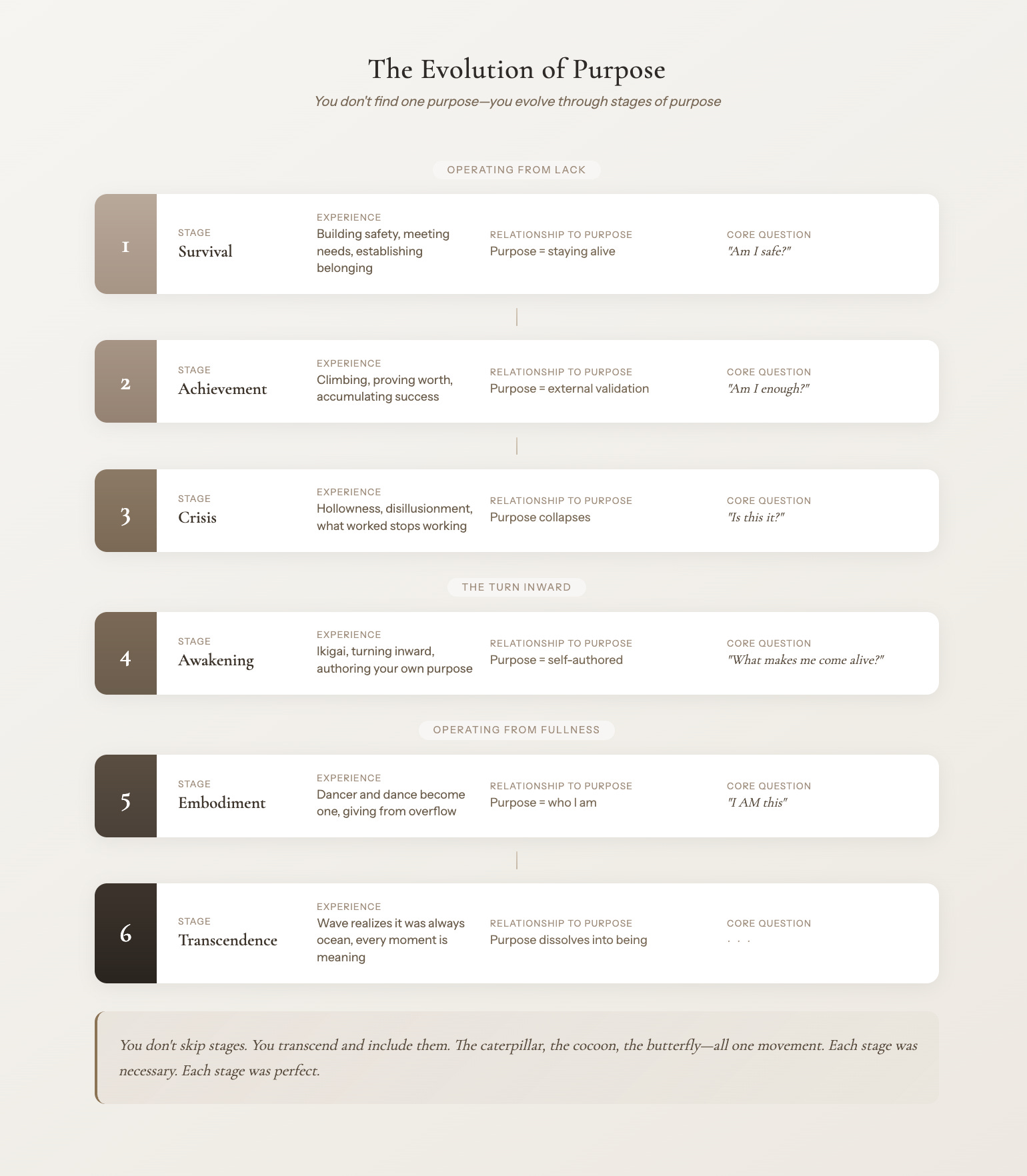
Your circle of care expands:
From caring for yourself (survival)
To caring for your achievements (success)
To caring for your authentic expression (self-actualization)
To caring for the whole (self-transcendence)
Eventually, you realize that the journey was the reward.
Each stage was teaching you what you needed to learn. The caterpillar, the cocoon, the butterfly, all necessary.
You don’t skip stages. You transcend and include them.
What you were at earlier stages doesn’t disappear. It gets incorporated into something larger.
The survival instincts remain, but they serve a greater purpose.
The achievement drive remains, but it’s directed toward something beyond ego.
The meaning-making continues, but it’s held more loosely.
Part V: When the Dancer Disappears
There’s a moment in every great performance when something shifts.
The dancer stops dancing and disappears into the dance.
What remains is pure expression. There’s no one there anymore, no ego seeking applause, no self needing validation, no performer chasing glory.
This is when the dancer and the dance become one.
And when we witness this, a performance where the performer has disappeared into the art.
It elevates all of us.
We recognize in them what’s possible in ourselves: the unity of being and doing, the overflow of love made visible.
From Seeking to Overflow
When you recognize that you are fully complete right now, that you lack nothing, that you are enough, your relationship with the world begins to change.
You stop operating from deficiency.
You start operating from fullness.
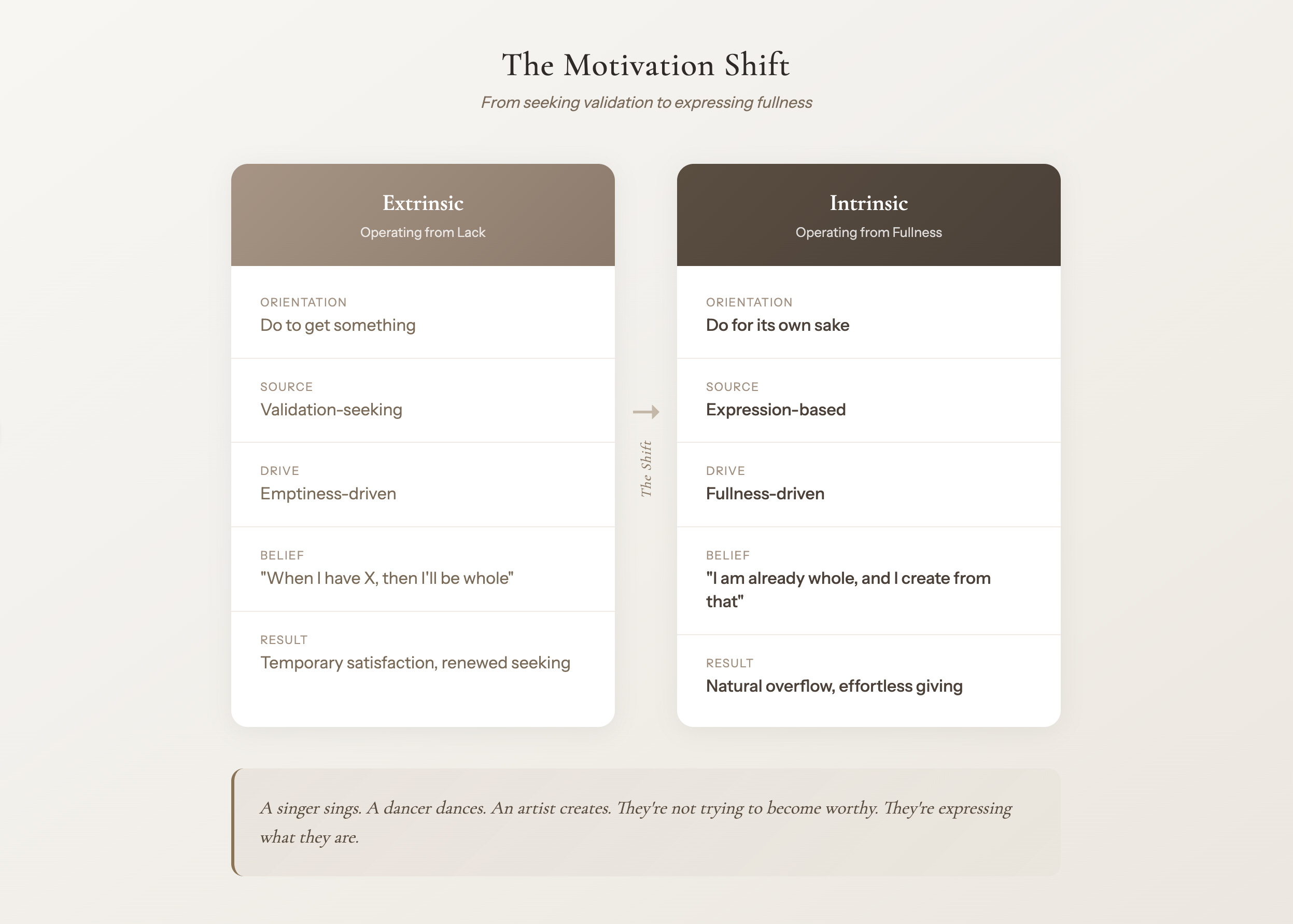
This is the shift from extrinsic to intrinsic motivation:
Extrinsic: “I do this to get validation, security, and proof of worth.”
Intrinsic: “I do this because I love it, for its own sake.”
A singer sings.
A dancer dances.
An artist creates.
They’re not trying to become worthy.
They’re expressing what they are.
The Paradox of Giving
When you give from emptiness, it’s obligation, duty, or an attempt to feel worthy.
When you give from a place of abundance, you are sharing your natural overflow.
You’re not sacrificing anything because you are giving others not what you HAVE, but rather WHO YOU ARE.
The paradox completes itself: Seeking fulfillment keeps you empty because it is an affirmation that you lack.
You don’t “find” purpose and then feel complete.
Instead, through crisis you awaken to discover your reason for being, and your purpose naturally flows from that recognition.
Your life becomes the expression of what you are, not the pursuit of what you lack.
In this scene, from Coco (2017), Miguel plays for Mama Coco not to achieve anything, but from pure love, and the music becomes a bridge between worlds.
Part VI: Living as Purpose
Michelangelo was once asked how he created David from a block of marble.
“I didn’t create David,” he replied. “David was always there in the marble. I just removed everything that wasn’t David.”
For years, the master worked with hammer and chisel, not to add something to the stone, but to reveal what was already present.
Each strike wasn’t creating; it was uncovering.
Each fragment that fell away brought forth more of what was always there, waiting to be expressed.
But here’s what most people miss about this story:
Michelangelo didn’t just reveal David; he revealed himself.
The sculpture became the sculptor’s self-portrait, not of his face, but of his consciousness made visible in stone.
The artist and the artwork were never separate.
They never are.
The Dance of Being and Becoming
In Kashmir Shaivism, they call this the dance of Shiva and Shakti.
Shiva is pure consciousness: eternal, unchanging, the witness.
Shakti is that same consciousness in dynamic expression: creating, destroying, dancing.
You are both.
You are the eternal awareness (Shiva) AND its creative manifestation (Shakti).
Not one or the other.
Both, simultaneously.
This is what Jesus meant when he said, “I and the Father are one.”
Not “I am trying to become one with the Father.”
Not “I am seeking the Father.”
But “I and the Father ARE one.”
Individual consciousness and universal consciousness have always been interconnected.
The wave was always the ocean.
In American Beauty, a dancing bag shows us how we can see the sacred in the ordinary.
Purpose Redefined
This changes everything about how you understand purpose.
Purpose isn’t a mission you need to discover.
Purpose isn’t a role you need to fulfill.
Purpose isn’t a contribution you need to make.
Purpose is consciousness expressing itself through your unique form, in this unique moment, in a way that could never happen through any other form.
Your very existence IS the purpose.
You don’t HAVE a purpose — you ARE purpose expressing itself.
Like a wave doesn’t have the ocean, it IS the ocean in that particular form, temporarily rising to express something the ocean needs to express.
Life as Art
When this clicks, life stops being a problem to solve and becomes art you’re creating.
Actually, that’s still not quite right.
Life stops being art you’re creating and becomes art that’s creating itself through you.
You’re the brush, the paint, the canvas, the artist, and the one witnessing the whole process.
All at once.
How do you know when you’re living this truth?
There’s a test: Would you gladly relive your exact life — every moment, every joy, every heartbreak, every triumph, every loss — again and again a thousand times over?
Not because it was perfect.
Not because it was easy.
But because you FELL IN LOVE WITH IT COMPLETELY.
This is Nietzsche’s eternal recurrence.
Not as a metaphysical claim, but as a litmus test for how fully you’re living.
When the sculptor becomes one with the marble, when the singer disappears into the song, effort transforms into effortlessness.
Work becomes play.
You become like a child absorbed in creation, needing no justification, no goal, no endpoint.
The final sequence from American Beauty (1999) captures this. Even after being murdered, he looks back with pure gratitude, saying, “There’s so much beauty in the world... I can’t feel anything but gratitude for every single moment of my stupid little life.” He represents the man who went through the midlife crisis, found himself and meaning through it, and saw a sparkle of the divine.
Part VII: The Purpose That Needs No Purpose
A student traveled for years to reach a renowned Zen master, desperate to find his life’s purpose.
“Master,” he said, “I’ve studied with teachers, read every text, practiced every method. Please, tell me my purpose.”
The master poured tea until the cup overflowed, tea spilling everywhere.
“Stop!” cried the student. “The cup is already full!”
“Exactly,” said the master, still pouring. “You came seeking purpose, but you’re already overflowing with it. You’re like a wave asking the ocean for water.”
The student protested: “But without purpose, what’s the point of anything?”
The master laughed. “Does the sun need a reason to shine? Does the rain need permission to fall?
When did you decide that existing wasn’t enough?”
In that moment, something shattered in the student.
Not broke — released.
Like a fist that had been clenched so long it forgot it was holding nothing.
He looked at the spilled tea forming patterns on the floor and saw the entire universe pouring itself out, purposelessly perfect, needing no justification for its overflow.
The Final Paradox
Here’s what no one tells you about this journey:
Every stage you’ve passed through — seeking, struggling, discovering, embodying — was perfect and necessary.
You couldn’t have skipped ahead to this recognition.
The seeking WAS the finding.
The journey WAS the destination.
Consciousness needed to dream it was separate to experience the joy of reunion.
Maslow discovered something near the end of his life that changed everything. Above self-actualization, he found another stage: self-transcendence.
At this stage, the “self” that was actualizing dissolves into something infinitely larger.
You don’t lose yourself — you discover that “yourself” was always a convenient fiction, a temporary costume consciousness wore to experience being “someone.”
The Spiral Complete
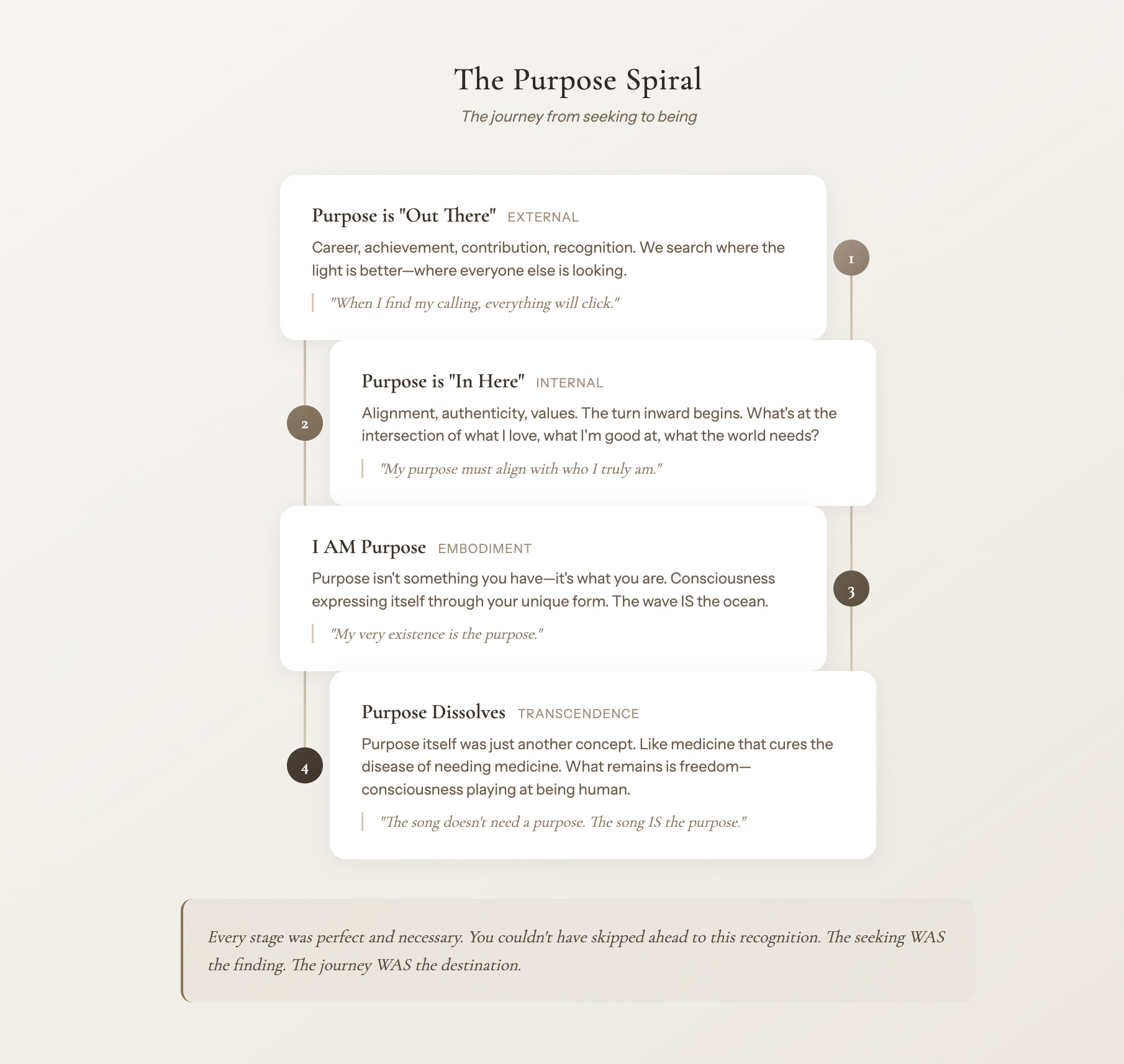
Watch what happens:
First you think purpose is “out there” (career, achievement, contribution).
Then you discover purpose is “in here” (alignment, authenticity, values).
Then you realize you ARE purpose (embodiment, expression).
Finally, you see that purpose itself was just another concept, another story, another game consciousness plays.
Your highest purpose is to realize you never needed one.
Like a medicine that cures the disease of needing medicine, purpose dissolves the very seeking that created the need for purpose.
What remains isn’t emptiness — it’s freedom. The freedom to be exactly what you are: consciousness playing at being human.
The Cosmic Joke
At this stage, something breathtaking occurs:
The separate self that was seeking purpose is seen to be another appearance in consciousness.
The seeker, the seeking, and the sought are revealed as one movement — consciousness experiencing itself through the illusion of separation.
You don’t HAVE consciousness. Consciousness has you.
Actually, even that’s not accurate — consciousness IS you, playing every role in this cosmic drama.
When this recognition dawns, you understand why the mystics laugh.
All that searching for meaning, and you WERE the meaning. All that longing for God, and you WERE what you were longing for. All that pursuit of purpose, when purposelessness was the ultimate purpose.
The cosmic joke: You were looking for your glasses while wearing them.
Everything Becomes Sacred
But here’s the beautiful twist:
This recognition doesn’t make life meaningless. It makes EVERYTHING meaningful.
When you’re no longer a separate self desperately trying to matter, every moment matters infinitely because there’s no “you” separate from it to judge whether it matters.
The rain falling. The coffee brewing. The heart beating.
All of it is the universe purposelessly purposing itself into existence, and you’re not witnessing it. You ARE it.
The Tree of Life is a beautiful expression of everything being sacred. The ups, the downs, all of it. Enjoy the clip.
The Return
The final stage isn’t sitting in a cave in blissful transcendence.
It’s coming back to the marketplace—enlightenment shopping for groceries.
Chop wood, carry water.
But now you know: The chopping IS the universe chopping. The carrying IS existence carrying itself.
You still live, work, love, create — but without the desperate need for any of it to mean something. It already means everything by simply being.
Your individual purpose? It was always just consciousness evolving, using your form to know itself more fully.
Every struggle pushed consciousness forward. Every question deepened its understanding. Every moment of suffering and joy added another note to the infinite symphony.
You were never separate from the whole. You were the whole, pretending to be a part, so it could experience coming home to itself.
Coda: The Bird’s Song
Like the bird singing her tune, your purpose is to do what you really love and share WHO you are with the world.
Not what you have. Not what you’ve achieved. Not what you’ve accumulated.
WHO YOU ARE.
The bird doesn’t sing to get something. She doesn’t sing to prove herself worthy of being a bird. She doesn’t compare her song to other birds and feel inadequate.
She sings because she’s full of song.
She sings because singing is what she IS.
And her song doesn’t need a purpose. Her song doesn’t need to accomplish anything. Her song doesn’t need to mean something.
Her song is purpose itself — consciousness delighting in its own expression through one small feathered form.
You are no different.
You are consciousness delighting in its own expression through one temporary human form.
Your life is your song.
And the song doesn’t need a purpose.
The song IS the purpose.
“Tell me, what is it you plan to do with your one wild and precious life?” — Mary Oliver
The answer was never a plan.
The answer is: Live it.
Fully. Completely. Without holding back.
Not because it will get you somewhere.
But because this — right here, right now — is the only somewhere there ever was.
The wave rises from the ocean, dances for a moment in the sunlight, and returns to the depths from which it came.
It never needed to find the ocean.
It was always the ocean, dreaming it was a wave.
And so are you.